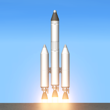
Developed by Team Curiosity, Spaceflight Simulator is a realistic sandbox game where you can build rockets and explore space. It brings the intricacies of orbital flight to mobile devices. Known for its accurate rocket physics and open, detailed solar system, the game offers players a seamless blend of creative engineering and scientific mission planning. Whether you're recreating the legendary Apollo or SpaceX launches or attempting your first moon landing, the intuitive building process and reliable orbital mechanics ensure an immersive gaming experience. Optimized for improved performance on mobile platforms, the Spaceflight Simulator APK provides a vast playground for aspiring rocket scientists.
Build your rocket the way you want
In Spaceflight Simulator, the building process is fully interactive. Players can build their dream rocket by adding boosters, tanks, engines, and structural components. The user interface is both user-friendly and detailed. Players can use round fairings to secure the payload and ensure optimal aerodynamics, while struts and outer skins provide stability and an attractive appearance. Establishing a balanced stage system is critical for launch, as physics simulations reward careful design. Unbalanced or structurally uncoordinated rockets can tip over during gravity turns, forcing players to iterate and refine their designs rather than just guessing repeatedly.
Realistic Orbital Mechanics and Mission Planning
The game's physics model replicates real-world orbital flight, providing an educational yet engaging challenge. Players must assess critical parameters such as apoapsis and periapsis, perform prograde and retrograde manoeuvres, and use transfer windows to travel efficiently between planets. To minimize downtime, a helpful "Transfer Window Time-Lapse" feature ensures smooth mission execution. The simulation accurately accounts for the complexity of circular orbits, orbital plane alignment, and planning of interplanetary transfers. For those looking for a bigger challenge, the "Hard" difficulty level offers demanding flight paths over long distances, while Challenge Mode removes all shortcuts and tests the pilot's skills only.
Target Acquisition, Docking, and Fuel Management
Rendezvous and docking maneuvers are optimized with intuitive targeting tools and docking aids that display relative velocities. Players can designate a station or ship as their target and use subtle RCS signals to refine their approach until a docking port is locked. The game also simplifies the control of complex vehicles by allowing users to adjust fuel levels in multiple tanks simultaneously and transfer fuel between modules to maintain balance. Occasionally, minor RCS glitches can occur, but these can usually be resolved using the in-game view and additional indicators. This makes docking a satisfying puzzle that requires precision and patience.
An open universe with realistic landings
The solar system in Spaceflight Simulator is vast and true to scale, with no invisible boundaries to distract from the gameplay. Players can explore Mercury, Venus, Earth, the Moon, Mars, and the Martian moons Phobos and Deimos, each offering unique terrain and challenges. Re-entry and landing in the game are hard-earned experiences. Players must enter the atmosphere, control the heat with a retrograde burn, and slowly deploy their parachutes. On airless bodies like the Moon, success depends on precise thrust control and observation of vertical velocity. These moments reflect the atmosphere of historic space missions and highlight the extensive planning required before a single engine is fired.
Challenge Mode, Space Center, and Progression
In addition to free play, the Space Center serves as a central hub for planning training missions and tracking achievements, allowing players to progressively develop their skills. Challenge Mode discourages cheating and encourages clean, practical solutions. Performance optimizations ensure the game runs smoothly even on standard hardware. For players looking to expand their creativity further, optional parts packs such as Redstone and Atlas are available, as well as expansions with unlimited building areas. The base game remains robust and prepares players through the training modes.
Deep Dive into Spaceflight Simulator Gameplay
The gameplay of Spaceflight Simulator is defined by a seamless blend of creative engineering and accurate physics simulation. It offers a sandbox experience where the only limits are the player's design skills and understanding of orbital mechanics. The core loop revolves around three distinct phases: constructing a rocket in the hangar, launching it into orbit, and executing complex missions to explore the solar system.
Engineering and Construction
The gameplay begins in the assembly building, where construction is entirely hands-on. Players have access to a wide array of parts—including boosters, engines, fuel tanks, fairings, and struts—to build their vessel from the ground up. Unlike simpler arcade games, the construction system requires attention to detail; players must balance the center of mass and thrust to ensure their rocket is stable. The interface allows for precise rotation and placement of parts, as well as the application of skins for customization. This phase is critical, as a poorly designed rocket will fail during launch, suffering from structural failures or flipping during gravity turns.
Realistic Orbital Flight
Once the rocket is built, the gameplay shifts to the launchpad and, eventually, the vacuum of space. The flight model is governed by realistic physics, meaning players cannot simply steer a ship to the moon. Instead, they must master orbital mechanics. Gameplay involves monitoring telemetry such as apoapsis and periapsis, executing timed prograde and retrograde burns, and managing staging sequences to reach orbit. To navigate the vast distances of space, players utilize "timewarp" to speed up the wait for transfer windows, making long-duration missions manageable without losing the sense of scale.
Advanced Maneuvers and Docking
For players seeking deeper challenges, the gameplay expands to include complex rendezvous and docking operations. Using targeting tools, players can intercept space stations or other vessels. A docking assist indicator helps manage relative velocity and alignment, turning what is typically a frustrating mechanic into a logical puzzle. Successful docking requires the use of RCS thrusters and careful fuel management, as players may need to transfer fuel between tanks to balance their ship for the return journey.
Planetary Exploration and Landings
Exploration is a major pillar of the gameplay, with an open, scaled solar system waiting to be discovered. Players can travel to Mercury, Venus, Earth, the Moon, Mars, Phobos, and Deimos. Each destination offers unique gameplay challenges: landing on Earth or Venus requires managing atmospheric reentry and deploying parachutes at the correct altitude, while landing on the airless Moon or Mars requires precise throttle control to manage vertical velocity. These missions capture the tension of real spaceflight, where a single miscalculation can result in a crash landing.
Game Modes and Progression
Beyond the free sandbox, the gameplay is structured through the Space Center hub. This area offers training missions that teach the basics of flight and docking, serving as a tutorial for new players. For veterans, Challenge mode strips away "cheats" and short-cuts, demanding perfect execution of missions. Hard difficulty further scales the distances to test the player’s ability to plan efficient trajectories. This mix of accessible creative tools and punishingly realistic physics ensures that the gameplay remains engaging for both casual builders and hardcore space enthusiasts.
Spaceflight Simulator: Pros & Cons
Based on hands-on testing and community feedback, here is a summary of the game's strengths and weaknesses:
Pros
- Approachable Building: Offers an intuitive construction system combined with realistic orbital mechanics.
- Open Solar System: Features a scaled, open universe with a wide variety of destinations.
- Quality of Life: Docking assist and transfer-window timewarp significantly reduce gameplay friction.
- Learning Support: Training missions and achievements are well-integrated to support player learning.
- Performance: Optimized for faster loads and smooth gameplay on mobile devices.
Cons
- Physics Quirks: Occasional minor issues with RCS behavior and docking alignment.
- In-App Purchases: Some parts and desirable features require additional purchases.